What are Transport Costs and how do you calculate and optimise them correctly?

Optimising transport costs is a key lever for profitability in road freight. Even small deviations in utilisation, route planning or procurement have a direct impact on your margin.
Fluctuating fuel prices, increasing competitive pressure and the high dependence on the utilisation of your lorries make stable costing more difficult. For many transport companies, the question is no longer whether they should optimise their transport costs, but how.
This article shows you which factors influence your transport costs, how these can be analysed systematically and which concrete measures you can implement in your day-to-day operations to sustainably reduce your costs.
What does optimising transport costs mean and which costs are included?
Optimising transport costs means deliberately reducing the cost of a shipment without compromising service quality. Unlike mere calculation, it’s not just about recording costs but about identifying and implementing specific levers for improvement.
The calculation of transport costs forms the basis for this. It shows how the individual cost components are made up and where economic potential lies. Only on this basis can well-founded decisions be made, for example on pricing, route planning or the utilisation of your lorries.
To deliberately optimise transport costs, you mainly need two things: a clear overview of your costs and the ability to actively manage them.
Which factors influence your transport costs?
Transport costs do not arise in isolation but from the interaction of several internal and external factors. Those who understand these influencing factors can specifically adjust the right controls and systematically exploit optimisation potential, for example in lorry utilisation, route planning or avoiding empty runs.
Fixed costs in the transport company
Fixed costs accrue regardless of whether your vehicles are in operation or not. They form the basic expenses of your business and must be covered on an ongoing basis.
This includes in particular:
Vehicle financing or leasing instalments
Insurance and taxes
Personnel costs for permanently employed drivers
Administrative costs and infrastructure
Because fixed costs remain constant, their economic burden increases when utilisation is low. High vehicle utilisation is therefore crucial to distribute these costs efficiently.
Variable costs in the transport process
Variable costs arise directly from carrying out a transport. They change with the number of kilometres driven, the utilisation of the loading space and the specific operating conditions.
Typical variable costs are:
Fuel costs
Toll charges
Maintenance and wear
Repairs and tyres
These costs can be influenced by operational measures, for example through optimised driving behaviour, proactive maintenance or efficient route planning.
External influencing factors
In addition to internal cost structures, external factors also affect your transport costs. These are usually not directly controllable but must be taken into account in planning.
This includes, among other things:
Fluctuating diesel prices
Seasonal demand and capacity utilisation
Availability of backloads
Traffic volumes and infrastructure conditions
Especially capacity utilisation and the availability of suitable follow-up jobs have a direct impact on the profitability of individual trips. Empty runs or inefficient routing can significantly increase the cost per transport.
How can you optimise transport costs in practice?
Optimising transport costs is not achieved through a single measure but through the interplay of several levers. What matters is that you consider both operational processes and strategic decisions.
Increase lorry utilisation and avoid empty runs
One of the biggest cost drivers in road freight transport is empty runs. Every unused kilometre generates costs without producing any revenue.
To improve the utilisation of your lorries, you can:
search specifically for return loads
combine transport orders more effectively
expand your network of shippers
High utilisation spreads fixed costs across more transported cargo and thus lowers the cost per order.
Systematically improve route planning
Choosing the right route has a direct impact on your cost structure. In addition to distance, factors such as tolls, traffic levels and driving times also play a role.
Optimised route planning helps you to:
to avoid unnecessary kilometres
reducing idle times
to better estimate/planned costs
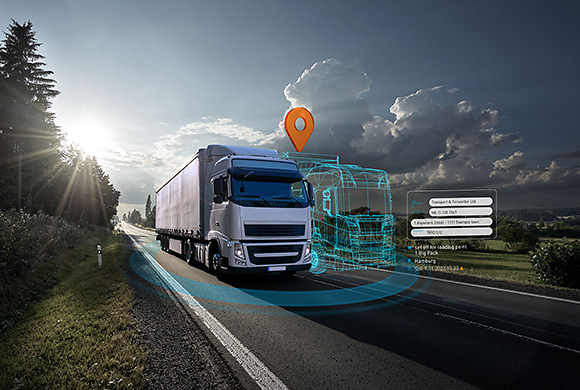
Digital tools can help you calculate routes efficiently and present costs transparently. These include, for example, route and cost calculation solutions, such as those available on the TIMOCOM Road Freight Marketplace with the service Routes & Costs.
Even small adjustments can lead to noticeable savings here.
Digitalise and automate processes
Manual processes take time and are prone to errors. Digital solutions make it possible to streamline workflows and create transparency.
Typical starting points are:
Digital order processing
Automated dispatch
Real-time tracking of shipments
Digitalisation reduces administrative effort and lets you make decisions based on up-to-date data.
Optimise purchasing and price negotiations
In addition to operational measures, procurement also plays an important role in cost optimisation. These include, for example:
Negotiations with fuel providers
Optimisation of insurance and leasing terms
Strategic selection of customers
Your own pricing is also crucial. Only when your prices reflect the actual costs can you operate profitably in the long term.
What role do digital solutions play in cost optimisation?
Digital solutions help transport companies not only reduce freight costs but also better understand and actively manage them. They create the necessary data basis to make informed decisions in everyday operations.
Using marketplaces to manage utilisation
Digital marketplaces such as the Road Freight Marketplace offer access to a wide network of potential business partners. They enable you to utilise spare capacity at short notice and secure additional transport orders.
For transport companies, this results in several advantages:
Faster response to fluctuating demand
Better utilisation of your lorries
Reduced empty runs through suitable follow-up jobs
Digital marketplaces thus make a direct contribution to reducing costs per kilometre driven. If you are not yet part of our road freight network, we recommend you to start testing the TIMOCOM Road Freight Marketplace for free. All you have to do is fill out your details and our experts will contact you soon.
Test the TIMOCOM Road Freight Marketplace
Context: digital tools vs. classic planning
Digital solutions do not replace the experience and operational know‑how within the company. They complement existing processes and support decision‑making.
It is important to make a realistic assessment:
Digital tools provide data and recommendations
The assessment and implementation will continue to be handled by dispatch and management
Not every process can be fully automated
The greatest added value is created when digital solutions are deployed specifically where they create transparency and simplify recurring tasks.
Typical mistakes when optimising transport costs
When optimising transport costs, the challenge is not only implementing measures but, above all, prioritising them correctly. In practice, certain false assumptions and approaches lead to savings potential remaining untapped or measures even having a negative impact.
Focus only on individual cost factors
A common mistake is focusing solely on individual cost items, such as fuel consumption or toll costs. However, transport costs arise from the interaction of various factors. If only one area is optimised, additional costs can occur elsewhere, for example through longer driving times or lower utilisation.
An effective optimisation therefore always takes the entire cost structure into account.
Lack of data basis
Without reliable data, transport costs are difficult to assess. Many decisions then rely on experience or assumptions that are not always correct.
Typical consequences are:
Inaccurate calculations
Faulty freight offers
Lack of transparency about the profitability of individual routes
A systematic collection and analysis of cost and performance data is therefore a prerequisite for any optimisation.
Short‑term rather than strategic optimisation
Measures to reduce costs are often taken at short notice, for example through spontaneous price negotiations or by choosing cheaper options on a case-by-case basis.
Such decisions can make sense in the short term, but they do not necessarily lead to a sustainable improvement in the cost structure.
In the long term, what counts is:
Stable utilisation of your lorries
Efficient processes
A clear pricing strategy
Only when operational measures and strategic alignment match can transport costs be optimised sustainably.
When is it particularly worthwhile to optimise your transport costs?
Optimising transport costs is fundamentally relevant for every transport company. In certain situations, however, it becomes especially important because direct effects on profitability and competitiveness become apparent.
Small vs. large transport companies
Smaller companies often have less financial leeway. Rising costs or inefficient processes therefore affect liquidity more quickly. At the same time, leaner structures offer the opportunity to implement measures more quickly and adapt processes more flexibly.
Larger companies, on the other hand, benefit from economies of scale. That means: as a company grows, the cost per transport falls, for example through better purchasing terms or more efficient utilisation of vehicle space. At the same time, structures are often more complex. Optimisations therefore require more coordination here, but when implemented successfully can achieve greater savings.
Lorry drivers vs. fleet operations
For individual lorry drivers, even small changes can have a big impact. Factors such as utilisation, route choice or fuel consumption directly determine the economic success of individual journeys.
In fleet operations, overarching topics are the focus, for example:
Central dispatch
Strategic route planning
Utilisation of the entire vehicle fleet
This is less about individual shipments and more about optimising the overall system.
Market situations and capacity utilisation
The market situation also influences how strongly optimisation measures take effect. In periods of high demand vehicles are easier to fill, while in weaker market phases competition increases. Especially with fluctuating capacity utilisation, it becomes clear how important flexible planning and access to additional transport orders are.
Companies that know and actively manage their cost structure can react more quickly in such situations and keep their profitability stable.
Optimise transport costs sustainably
Optimising transport costs is an ongoing process, not a one-off project. It requires transparency about your cost structure, an understanding of the main influencing factors and the consistent implementation of suitable measures in day-to-day operations.
The key is to combine operational and strategic approaches. High utilisation of your lorries, efficient processes and sound costing form the foundation for commercially successful transports.
Digital solutions can help you make data available and support your decision-making. However, you achieve the greatest impact when you integrate them purposefully into existing processes and combine them with your operational know-how.
Who systematically analyses and actively manages their transport costs creates the precondition for stable margins and long‑term competitiveness in road freight.
Why do we write about logistics? Because for over 25 years we have been bringing freight and vehicle space together. With more than 58,000 customers, the TIMOCOM Road Freight Marketplace is one of the leading logistics networks for road transport in Europe. Would you like to stay up to date with the latest news? Join our mailing list and receive updates directly in your inbox.
Paula Bongers
Content Marketing Manager